Researchers from BIO-INTEL-MOB partner, University of Rijeka, have published a new academic article exploring the role of artificial intelligence in transforming peri-urban mobility and logistics.
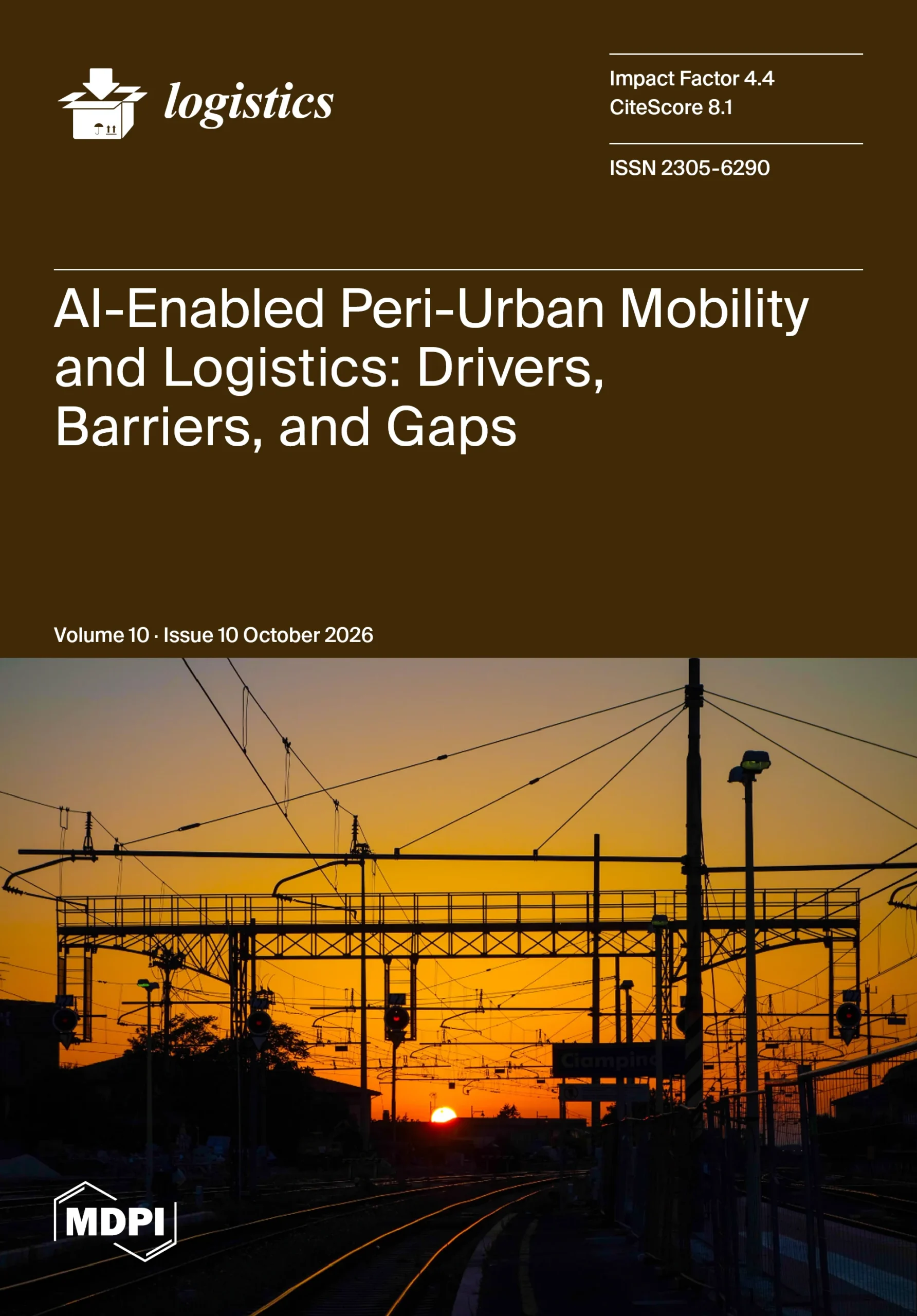
Researchers Saša Aksentijević, Matej Plenča and Edvard Tijan, together with Marija Jović Mihanović from, ISL, have published and article entitled “AI-Enabled Peri-Urban Mobility and Logistics: A Structured Literature and Project-Based Review of Drivers, Barriers, and Integration Gaps”. The article has been published in Logistics, an international academic journal by MDPI, in Volume 10, Issue 10 (October 2026). In recognition of its contribution to the field, it has also been selected as the issue’s Cover Story.
How can artificial intelligence, mobility data and digital technologies be brought together to make transport and logistics systems more sustainable, accessible and efficient beyond city centres? The research explores this question and identifies the key conditions needed to turn technological innovation into practical solutions.
Looking beyond city centres: the importance of peri-urban mobility
The research addresses a dimension of transport planning that has received comparatively less attention than mobility in dense urban centres: peri-urban areas, situated between cities and rural settlements. These territories face a distinct combination of challenges, including longer journeys, high dependence on private cars, limited and fragmented public transport, weak first- and last-mile connections, congestion and growing pressure to make goods distribution more sustainable.
The article argues that solutions designed for dense urban environments cannot simply be transferred to peri-urban areas without adaptation. Their specific spatial characteristics, lower service densities, fragmented institutional responsibilities and different mobility patterns require approaches that integrate transport, logistics, technology and governance.
To examine these challenges, the researchers combined two complementary strands of analysis. The first was a structured review of 211 scientific publications from 2015 to 2026, identified through Web of Science and Scopus. The second was a project-based review of 124 EU-funded mobility and logistics initiatives, selected from an initial pool of 16,627 candidate projects. Together, these sources provide an overview of the research landscape and the practical approaches being explored across European projects.
Three interconnected areas of innovation
The study organises its findings around three concepts that are also central to the BIO-INTEL-MOB research approach:
- Green-Safe Routing Algorithms (GSRA): AI-enabled routing approaches that consider several objectives simultaneously, including environmental performance, road safety and travel reliability. Rather than optimising routes solely for speed or distance, these approaches seek to balance different mobility priorities.
- Peri-Urban Mobility Hubs (PUMHs): multifunctional hubs that connect public transport with shared mobility and other services, while potentially accommodating logistics and freight activities. Their strategic location and integration can help address first- and last-mile gaps, improve connections between transport modes and support more efficient passenger and goods movement.
- Smart and Collaborative Governance (SCGo): governance approaches that bring together data, public authorities, transport operators, researchers and citizens. The emphasis is on ensuring that technological solutions are supported by coordinated decision-making, stakeholder participation and policies adapted to local needs.
The article examines how these three areas depend on one another. Routing algorithms require reliable and interoperable data; mobility hubs need to be integrated into wider transport and logistics networks; and both require governance arrangements that enable coordination, accountability and long-term implementation.
The central finding: the challenge is integration, not technology alone
One of the study’s most important conclusions is that the main obstacle to advancing AI-enabled peri-urban mobility is not necessarily a lack of individual technologies. Instead, it is an integration deficit: promising solutions often develop separately, without the technical, organisational and institutional connections needed to operate as part of a coherent system.
The research identifies several recurring barriers:
- Fragmented governance: responsibilities are distributed across different municipalities, regions, authorities and organisations, making coordinated planning and implementation difficult.
- Limited and fragmented mobility data: incomplete datasets, inconsistent formats and weak interoperability restrict the ability to develop reliable AI applications and evidence-based transport planning
- Difficulties in scaling innovation: many initiatives demonstrate promising technologies through pilots, but translating these demonstrations into sustainable, long-term operational models remains challenging.
- Unequal access and digital exclusion: technology-led mobility services can leave certain groups behind if accessibility, affordability, digital skills and different user needs are not addressed from the outset.
- Insufficient integration of passenger mobility and freight: transport hubs, logistics services and circular distribution systems are often planned separately, despite sharing infrastructure, space and network constraints.
The review also finds that governance and institutional capacity frequently lag behind technological development. In other words, even sophisticated AI tools cannot deliver their full potential without appropriate data arrangements, organisational coordination, policy support and meaningful citizen participation.
What needs to happen next?
Based on the combined evidence, the authors identify several priorities for research, policy and implementation. These include developing interoperable mobility data governance arrangements, designing AI systems that are transparent and inclusive, adapting mobility hubs to different peri-urban contexts, and strengthening coordination between passenger transport and freight logistics.
The study also stresses that AI should not be treated as a universal solution. Its effectiveness depends on the quality and availability of data, the context in which it is deployed, the capacity of institutions to use its outputs and the safeguards in place to ensure fair and accountable decision-making. Human oversight, accessibility and equity therefore need to be considered as integral elements of system design.
For cities, regions and transport operators, the researchers recommend planning across functional urban areas rather than focusing exclusively on individual municipalities. They also underline the importance of involving citizens through accessible participation channels, including options for people who cannot or do not wish to use digital tools.
BIO-INTEL-MOB as an integrated research example
The article also discusses BIO-INTEL-MOB as an instructive example of an integrated approach to peri-urban mobility. It brings together an Advanced Mobility Data Space, Peri-Urban Mobility Hubs, Green-Safe Routing Algorithms, bio-packaging and circular-logistics units, digital-twin ecosystems and a Smart and Collaborative Governance framework.
By considering these elements within a single project, our projects aims to prove the kind of integrated approach that the review identifies as necessary to move beyond isolated technological demonstrations and towards more coherent mobility and logistics systems.
The publication contributes to the project’s wider research activities by placing its themes within the broader European landscape of scientific research and innovation, while identifying the institutional, technological and social conditions that can support the transfer and scaling of new solutions.
Its selection as the Cover Story of Logistics, Volume 10, Issue 10, provides additional recognition and visibility for the researchers’ contribution and an opportunity to disseminate the project’s research themes and findings to the wider academic, policy and mobility communities.
Read the full article: AI-Enabled Peri-Urban Mobility and Logistics: A Structured Literature and Project-Based Review of Drivers, Barriers, and Integration Gaps
Journal: Logistics, Volume 10, Issue 10, October 2026 (MDPI).