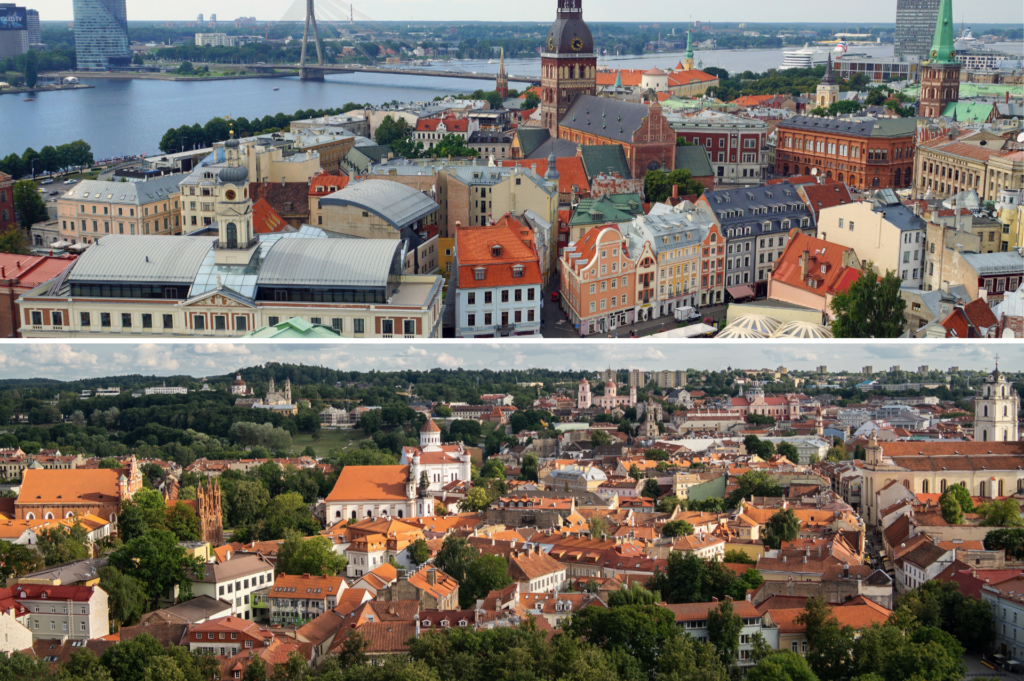
VILNIUS & RIGA

VILNIUS-RIGA MEGA PILOT

Integrating data and analytics to improve mobility and safety systems


Vilnius and Riga are two capital cities in the Baltic region, located within the same regional corridor and facing similar mobility challenges across their urban and peri-urban areas. In both cities, transport systems generate large amounts of data, but this information is often fragmented across operators and platforms, limiting its use for real-time management and planning.

The pilot runs in parallel in both cities, each testing solutions locally while contributing to a shared data framework. Its core focus is the development of a unified data environment that integrates information from traffic systems, sensors, satellite data, and citizen input into a single platform. 

In practice, Vilnius and Riga test how these tools—such as real-time routing systems, Digital Twin simulations, and AI-based monitoring—can improve traffic flow, increase safety for vulnerable users, and support more responsive decision-making. By working on the same technical components in two different contexts, the pilot can compare results and refine solutions for wider use.
 

CONTEXT

Vilnius and Riga operate across urban and peri-urban areas where mobility systems, data sources, and services are not fully connected.

CHALLENGE

Fragmented data, limited multimodal coordination, and safety risks for pedestrians, cyclists, and micro-mobility users.


IMPACT

Better use of data for decision-making, safer conditions for users, improved coordination between transport modes, and more efficient traffic flows.

Key actions

  • Advanced Mobility Data Space (aMDS)

    A unified data system that integrates inputs from sensors, traffic networks, satellite data, and citizen feedback into a single platform, enabling real-time monitoring and coordination of mobility systems.

  • Predictive analytics and AI models

    Data-driven tools that analyse traffic patterns, identify bottlenecks and safety risks, and support real-time and forward-looking decision-making.

  • Digital Twin

    A simulation environment that replicates real-world conditions, allowing cities to test infrastructure changes, policy measures, and operational scenarios before implementation.

  • Green-Safe Routing Algorithms (GSRA)

    A routing system that provides safer and lower-emission routes for everyday mobility, using real-time data to adapt to traffic conditions and prioritise vulnerable users.

  • Citizen-Voice App

    A mobile application that allows residents to report safety issues, accessibility barriers, and mobility needs, providing real-time input to planners and supporting more responsive interventions.

Cooperation with Pilots

Vilnius & Riga

Collaboration on the advanced Mobility Data Space (aMDS), a shared data platform integrating mobility and logistics data from multiple sources to enable interoperable data sharing, real-time analytics, and cross-city comparison.

Rome

Joint development and testing of Green-Safe Routing Algorithms (GSRA) and Peri-Urban Mobility Hubs (PUMHs), combining routing tools with physical infrastructure to improve safety, efficiency, and multimodal connectivity.

All mega pilots

Alignment on the Smart City Governance framework (SCGo), including the use of the Citizen-Voice App, gamified planning tools, and VR/AR simulations to support citizen engagement and co-design across different urban contexts.

Partners Involved