First results from BIO-INTEL-MOB’s state-of-the-art and innovation gap analysis
Peri-urban areas are growing, and so are the mobility challenges that come with them. Longer trips, high car dependence, infrequent public transport and weak first- and last-mile connections make these areas very different from dense city centres. Yet research and innovation in mobility and logistics have mostly focused on urban cores.
BIO-INTEL-MOB’s first public deliverable, D2.1 State-of-the-Art and Innovation Gap Analysis Report, looks at what this means for the design of new solutions. Drawing on a literature review and research questionnaires, partners identified several key barriers to mobility in peri-urban areas (see Figure 1).
Peri-urban areas are missing integration, not technologies
The evidence reviewed points to a clear conclusion: what is missing is not technology, but integration. AI tools, data platforms, Digital Twins and mobility hubs are advancing quickly, but are often developed in isolation and tested under urban conditions. Governance tends to lag behind technology, and many projects reach the pilot stage without a clear path to long-term deployment.
Peri-urban areas make these problems more visible. Responsibilities are spread across municipal, regional and national authorities, data are patchier, and coordination between land use, transport and logistics is often weak. The main barriers to adopting AI-enabled mobility solutions are institutional and organisational rather than technical.
Urban solutions do not travel easily
Many applications considered well established in cities, such as adaptive traffic signal control, traffic flow prediction or smart parking, are still limited or emerging in peri-urban settings. Models trained on dense urban sensor networks may perform poorly where data coverage is thinner and demand more dispersed, as it is often the case in peri-urban areas. In practice, Digital Twins often serve as visualisation tools, when they could actively support operational decision-making.
Logistics: from last mile to closed loops
A similar urban bias can be seen in freight transport. Cargo bikes, electric vans and micro-hubs have proven beneficial in dense city centres. In peri-urban areas, however, due to longer distances and fewer constraints, conventional vehicles can be more efficient, unless consolidation and intermodal solutions are in place.
Circular logistics and bio-based packaging show strong potential for peri-urban areas, yet real-world uptake remains low. Forward and reverse flows are often managed as separate systems, collection infrastructure remains uneven, and uncertainty persists for many users on how to dispose of compostable materials. Renewable energy provided at logistics hubs is promising, but still largely tested in urban pilots.
Concerns and interests from local stakeholders
Early input from stakeholders in the project’s pilot, satellite and scalability sites points in the same direction. Car dependence, poor connections between city outskirts and centres, and risks for vulnerable road users emerged as some of the main concerns. Data sharing between operators and public authorities also remains limited.
There is, however, clear interest in peri-urban mobility hubs connecting passenger and freight services, route planning that takes emissions and safety into account, and tools that help organisations keep up with EU regulations.
Interviews revealed that peri-urban mobility hubs should reflect real travel flows. Additionally, they indicated that sharing kerbside space between passengers and freight can be effective when supported by clear time allocations. Limited cooperation between parcel providers has also proven to be a significant barrier in smaller towns.
Contributing to BIO-INTEL-MOB goals
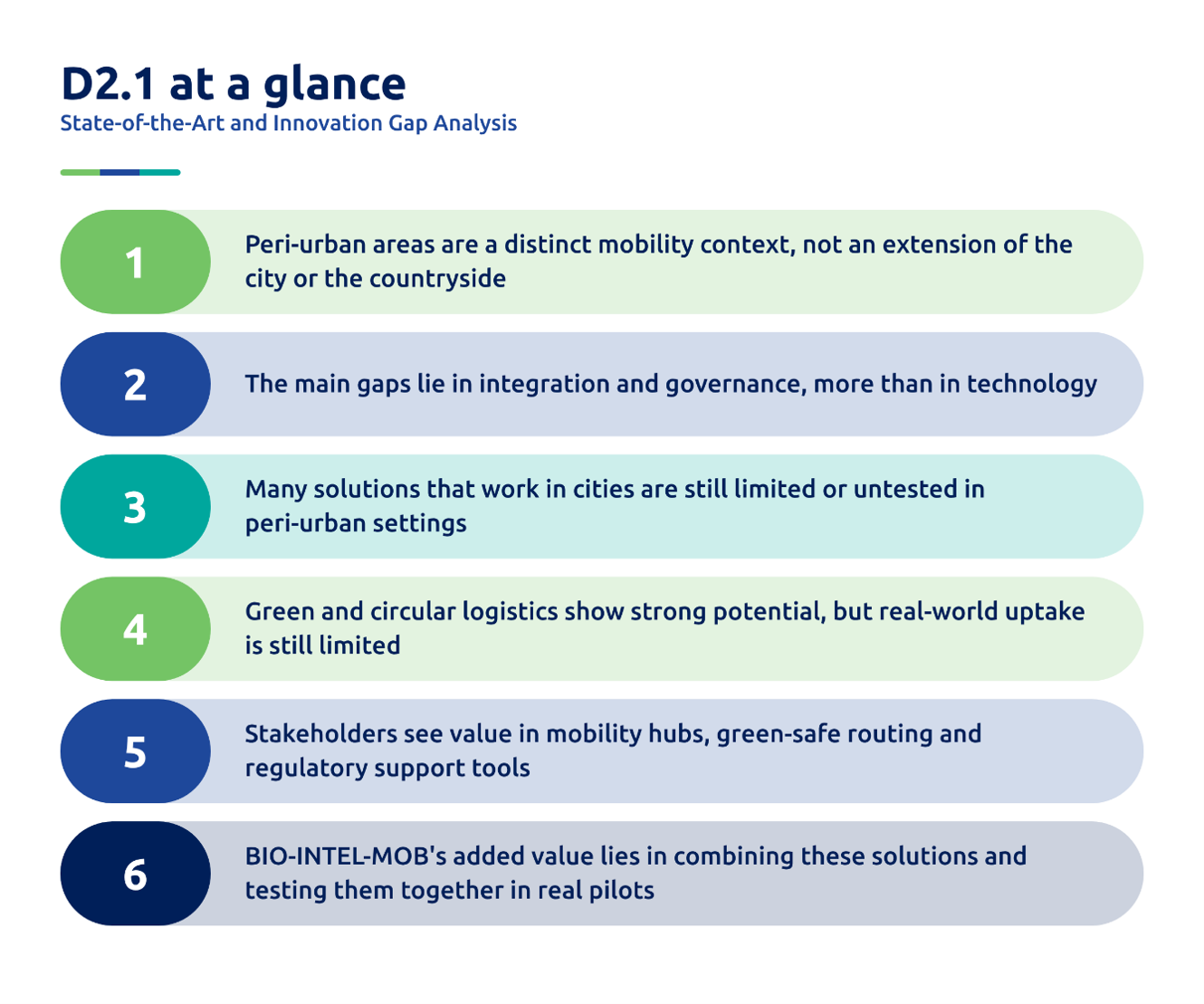
Deliverable 2.1 is not only a review. It sets the agenda for the project’s next steps. Translating the gaps identified into concrete priorities (See Figure 2), it will guide BIO-INTEL-MOB’s technical development, pilot implementation and impact assessment.
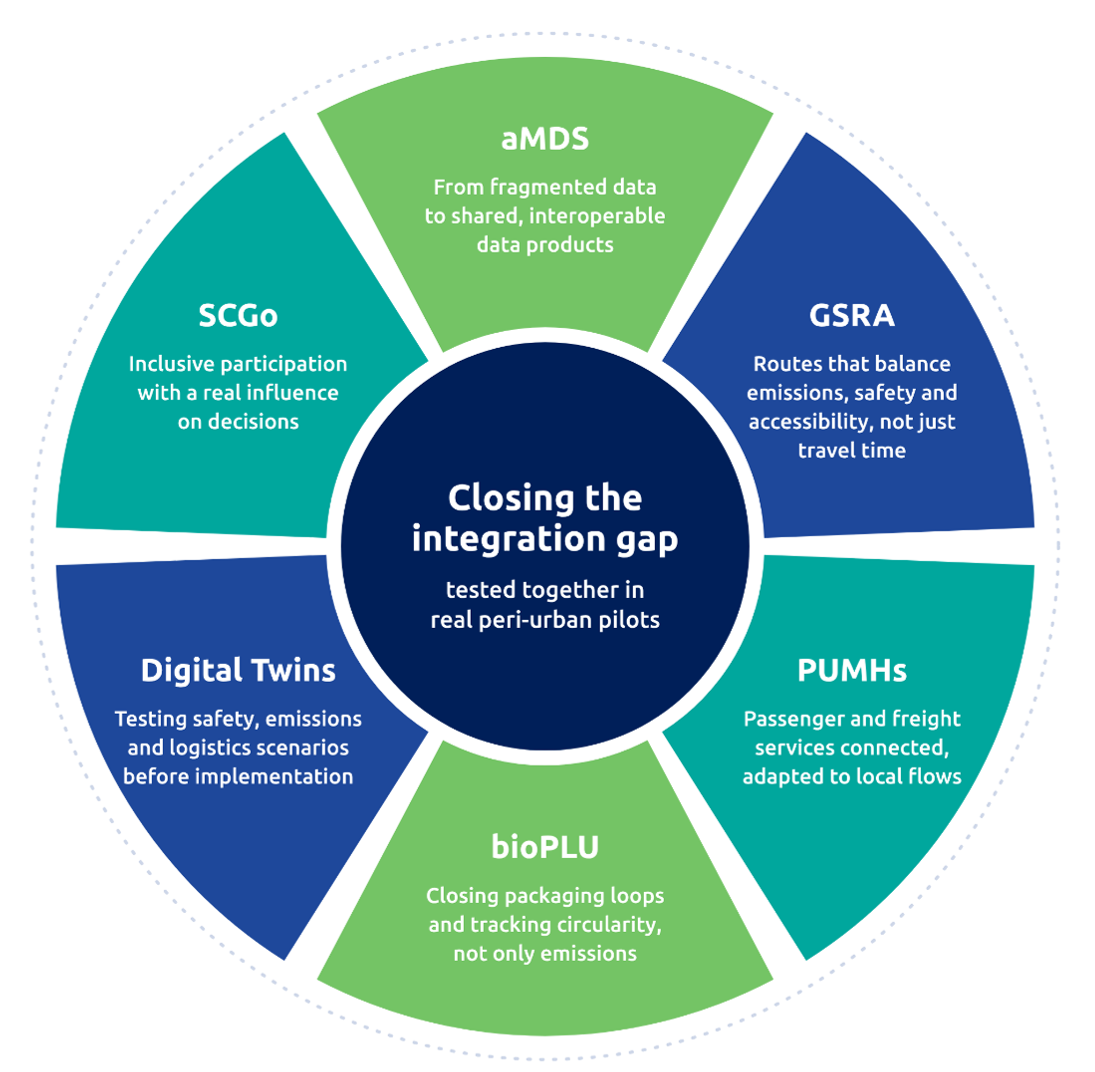
In practice, this means designing solutions for peri-urban conditions from the start, rather than adapting urban ones afterwards. Examples include defining hub typologies that combine passenger, freight and accessibility functions; developing routing systems that are explainable, with visible trade-offs between safety, emissions and accessibility; and offering participation channels that do not depend on digital solutions. Just as importantly, governance and data management should be treated as integral parts of the design process, not as an afterthought.
To foster BIO-INTEL-MOB’s accountability, D2.1 proposes indicators that go beyond the project’s final outcomes, and track whether ongoing activities contribute to narrowing the gaps identified in pilot, satellite and scalability sites. These indicators range from the share of data available through governed interfaces to the number of policy decisions tested in a Digital Twin before implementation.
With pilots in Rome, Cascais, Riga and Vilnius, satellite, scalability and follower sites across Europe, BIO-INTEL-MOB now has the opportunity to turn these insights into practice and show how peri-urban areas can become test beds for safer, greener and more inclusive mobility.